Showing posts with label Germantown Academy. Show all posts

Monday, January 13, 2014

Roald Dahl Author Study (January 2014)

Roald Dahl is one of my favorite authors and so when deciding where to go next with our guided reading groups I was happy to take on the task of designing a Roald Dahl author study for the whole class. First things first, I gathered as much information about Roald Dahl as possible to put together a bulletin board and introductory lesson.

Reading With Roald Dahl Bulletin Board


As I researched the man I considered to be one of my favorite authors I realized I fell in love even more. Not only was Dahl a fascinating writer that captured readers' attention with wild and wacky stories, but he had lived the most extraordinary life. I couldn't wait to share it with my students through the Smart Notebook lesson I created.


Afterwards, we took a tour of Roald Dahl's amazing author webpage to explore the many fun activities on the site. It is a tremendous resource for teacher activities and information about the author and his books. In addition, there are fun class games and activities. The first one we took on was a writing exercise. Part of what makes Roald Dahl such a fascinating writer is that he uses interesting language (instead of saying "beautiful" he says "dazzling"). Part of his method was to collect lists of words under a heading. I explained to the class that this was a good exercise for great writers to keep an arsenal of words in case they are ever at a loss of how to put something. As a class we chose to list words that we thought fell under the category of "funny". The students came up with words such as hysterical, hilarious, laughable, unbearable, and goofy. At the end of the lesson I charged the students with never again going with the same old boring funny when writing a story again, but to refer back to our list and use one of our fabulous new and interesting words that mean just the same!

The class is split into three different reading groups. I have a group of readers that are on grade level and we have the pleasure of reading one of my absolute favorites, Fantastic Mr. Fox. The students learned what an antagonist is and discussed what exactly makes someone an antagonist. I put together a study guide that contains not only plot and inferential questions, but also includes activities that have the students looking for and even creating figurative language of their own. 

We are still in the midst of reading our books and playing with figurative language. As a final project students will work together as a group to create a sequence of events for the novel within a depiction of our hero, Mr. Fox. Seeing the kids excitement over Roald Dahl and his books has solidified for me that Roald Dahl was successful in his mission: "I have a passion for teaching kids to become readers, to become comfortable with a book, not daunted. Books shouldn't be daunting, they should be funny, exciting and wonderful; and learning to be a reader gives a terrific advantage."

More updates to come as we complete our projects and finish other wacky and wonderful exercises. Next week, the kids will create their own new words and give them life (definitions and illustrations) just as Roald Dahl did!


Student Worksheet: After students
developed a list. They individually
selected one to illustrate for our
class dictionary.

Student Worksheet: Students worked
in pairs to come up with their own
"gobblefunk". We had a pre-lesson on
prefixes and suffixes.

GIRLS Group

Last year, a colleague approached me towards the middle of the year about an idea of hers to help teach the fifth grade girls how to have healthier friendships and be strong, independent women. I was happy to jump in on the project and lead the lunchtime program with her because I was noticing a lot of the same issues in the fourth grade as well. We worked together to plan weekly lessons that centered on positive thinking about topics such as body image, friendships, conflict resolution and other issues important to young girls.
This year we have continued our efforts in GIRLS Group extending the program throughout the year to allow more time for each topic. The benefit of working together on this project is not only to have a team member to provide another point of view on issues, but also it helps model the behavior we try to instill in the fifth grade girls because of how well we work together. We are good friends and can use our collaborative work in school and outside of school to share stories of how, even though we are adults, we understand what it is like to be a girl going through these situations.

Click here to see a story posted on the Germantown Academy website about our group this year.

Sunday, January 12, 2014

Reflections


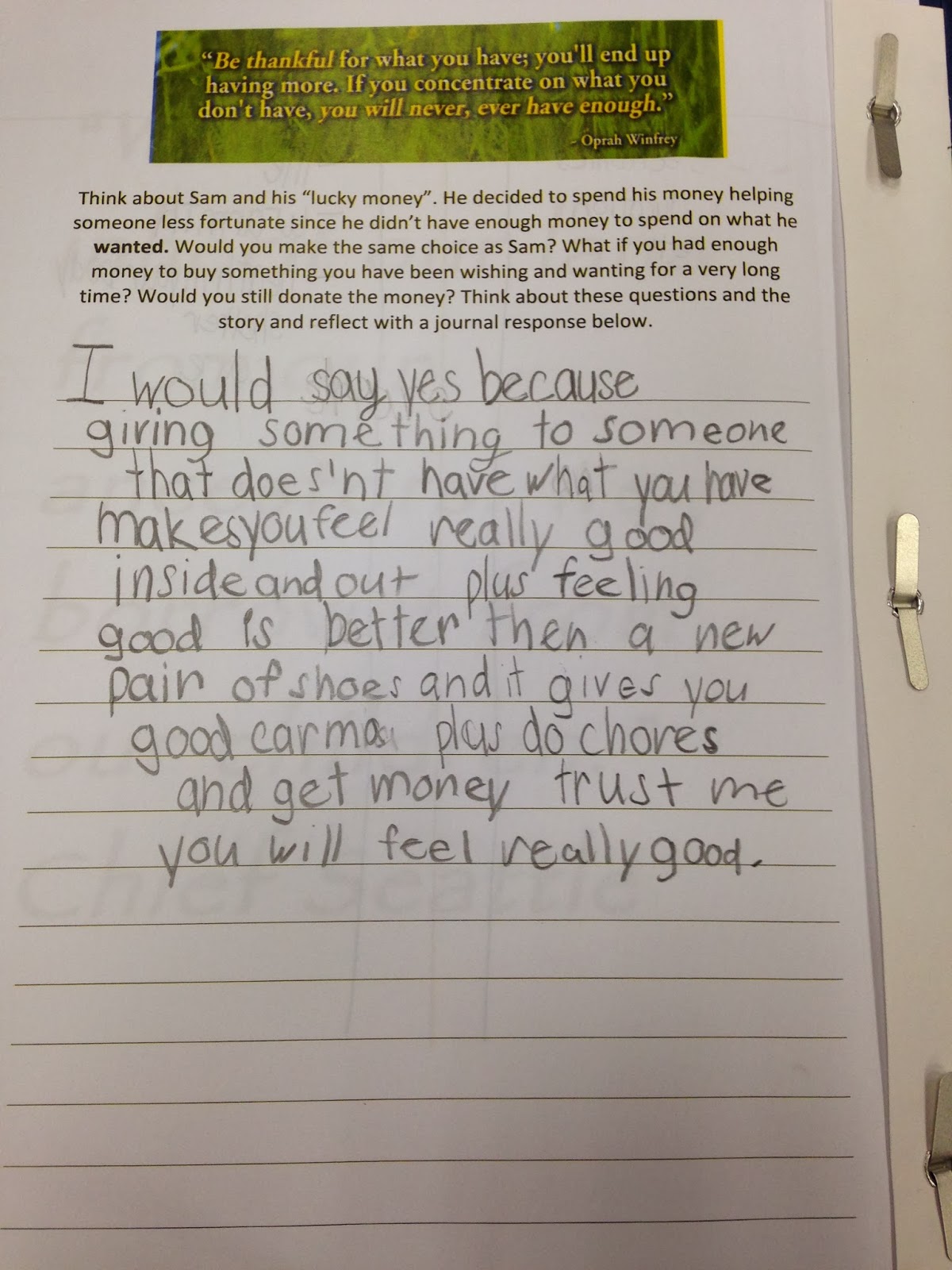
At the beginning of the year, the head of the lower school and I had a similar dream for the year ahead. I had learned about the book Rhinos and Raspberries: Tales of Tolerance for the Early Grades by Lois Lowry during my time at Friends Select School and was interested in bringing it to the curriculum at GA. Many of these tales of tolerance relate to the five pillars of the mission statement and lead to rich discussions on character and social development, something I found lacking in the classroom last year. The head of the lower school had a brilliant idea of starting a program for the coming year of "Mission Stories" that we would carry around with us in our backpacks. These stories would come from faculty, staff and students telling of times when we felt the mission was being lived to serve as a reminder of what it truly means to be independent in thought, compassionate in spirit, confident in expression, honorable in deed and collaborative in action. I took this as a sign that I should start my own mission curriculum in the classroom this year called Reflections. Thus far in the year I have used inspirational quotes to inspire kids to discuss moments when someone is upholding the mission statement. 

Example of student response to reflection
lesson.
The quote featured at the beginning of this post is from the Reflections lesson I organized in November. To go along with the Thanksgiving holiday I decided to tie in thankfulness to the lesson. To begin we listened to Sam and the Lucky Money by Karen Chinn, a story of a young boy who discovers that what may seem like not enough money to him could be a great gift to someone less fortunate. After hearing the story students had a discussion about how Sam was living the mission statement. The students all agreed that Sam was compassionate in spirit when he donated his gift of "lucky money" to the poor man on the street instead of spending it on himself. After our group discussion the students were then asked to reflect on the story and respond to a writing prompt.
This lesson along with others has been a great monthly exercise for the students to remind them what it means to live the mission.

Thursday, January 9, 2014

Anagram Poems

A colleague of mine stopped by with a fascinating book recommendation. This was a lesson for me that one of your most valuable resources as a teacher is a great librarian. Ours is constantly stopping by with interesting books to support the curriculum she sees us teaching in the classroom. This day it was a poetry book called Lemonade: and Other Poems Squeezed from a Single Word by Bob Raczka.


I was excited about it because I like to try to do poetry at least once a month in the class because students who are just beginning to blossom as writers often have fun with the lyricism and freedom of poetry. In this case the poems were all developed from words created from other words. This not only was a great exercise in poetry, but a great word study activity. So I created a Smart Notebook Lesson to show off some of my favorites from the book. After the students heard some samples I gave them the task of creating words from the phrase "Monster Mash" since it was Halloween. As a motivational tool I told them I had come up with 53 different words that could be made from Monster Mash, instantly the students began working furiously to beat my record. The students worked collaboratively in table groups to come up with as many words as possible. I gave reminders that the words should try to fit with the idea of Monster Mash and Halloween so that the poem would make sense and had to hint at the importance of having small words like is and at to construct a cohesive poem. As with the nature of teaching the plan changed mid-lesson. The students were having such a good time creating words from Monster Mash that most of our time was taken up working on the word study piece of the lesson and less on constructing a poem. At the end of the class we put up some of the words the class had created and came up with a few different stanzas that could potentially become a very spooky, zany Halloween poem!

Comparing/Ordering Numbers

Early in the year the students were reviewing how to compare and order numbers. We first reiterated the importance of understanding place value in a number. Then, students were able to use the understanding of place value to help them evaluate where numbers might fall on a number line. As a fun practice the students were given the opportunity to get up and move around. Each student was given a few number cards that they then had to order on a clothesline across the room.

What I particularly enjoyed about this activity was that not only were they practicing a valuable math skill, but they were working collaboratively to do so. It is important for me as a teacher to see kids develop the problem solving skills necessary to working in groups. In business school we learned the four stages of group work-- forming, norming, storming and performing. I believe it is key to begin building the skills necessary for resolving conflict independently in third grade so that they can successfully work together in groups. Since it was the beginning of the year it was helpful to build a strong classroom community with expectations for the students to work together cooperatively and compassionately. The extra challenge to their task? No talking! The students were able to effectively communicate non-verbally with their classmates.

Taste the Array


Every chance I get I try to make learning as fun and interactive as possible, especially in math. As a student I struggled with math because I was taught through algorithms and rote memorization. As a kinesthetic and visual learner this method of teaching did not work for me. Often times after days of learning a new skill I will allow the students the opportunity to work with manipulatives to strengthen their understanding of the topic.

In this particular case the students were just beginning to learn about multiplication concepts. We began the unit by working with familiar concepts such as the relationship between repeated addition and multiplication as well as visualizing multiplication through building arrays. Once the students had learned how arrays can help us solve multiplication problems the students then had the chance to build their own using a fun (and delicious!) tool. We played a game called "Taste the Arrays" using skittles to build four different arrays.

The students were given charts to keep track of their work:


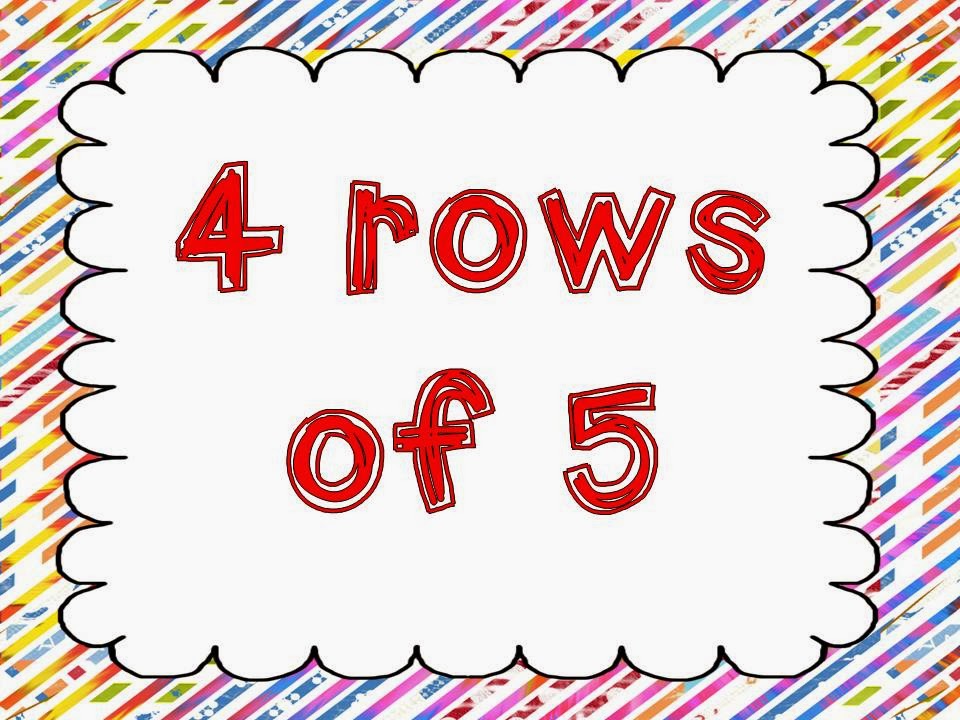
On each section the student would build an array that I displayed on the board (ie 4 rows of 5) using their skittles. Once they had correctly built the array they then had to write the multiplication sentence (4x5=20) in the space provided as well as the repeated addition (4+4+4+4+4=20).

Once they finished all of their arrays they were treated to a few of their skittles. The students not only loved having the treat at the end of the day, but really practiced their understanding of the different forms a number can take when multiplying.


Wednesday, January 8, 2014

A Lesson on Curiosity

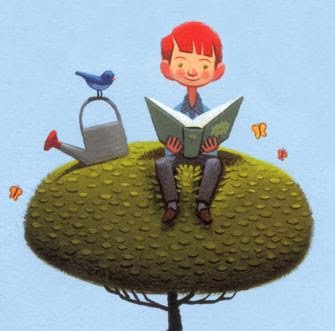
As a teacher I have always liked the idea of having my students notice and wonder when approaching learning. One word I use to describe myself is curious. I have always had a curious mind. I am constantly learning and looking up new things. One lesson that I recently did with the kids in 4W was focused around this idea of curiosity. I put up a page on the SmartBoard that simply had the word "curious" in the center. I then asked for students to volunteer ideas of what the word curious means to them. Students came up with words and phrases like “full of wonder” and “odd, yet interesting” capturing both of the definitions of the word curious. We then read a wonderful book called The Curious Garden by Peter Brown. The book is about a little boy who lives in a dreary and boring city with no green. He is tired of looking at the drab scenery so he envisions and starts building a garden full of color and life. The garden begins to grow and spread throughout the entire city. What I love about this book is that it shows that even the smallest of ideas can make a big difference. One little spark can set fire to a whole new world. After discussing the book and how the curious little boy made a difference I present the task to the students of looking at the world around them and what they might change about it. How can they make the world better? What would they like to inspire others around them to do? We took a walk out to the nature preserve on campus to give them fresh air and a pleasant setting to think of how they plan to make an impact on the world. Students were collecting litter they found and pressing flowers in their journals. The students were creative and inventive in the ways they thought about our campus and how they could make it even more beautiful.